
This post contains affiliate links. If you make a purchase through these links, we may earn a small commission at no extra cost to you, which helps support our Scholarship Program.
Welcome to February. The longest shortest month of the year.
Here in the Midwest, February can feel especially hard. We know spring is so close, but winter hasn’t quite let go yet. The novelty of snow has worn off, the cold weather is limiting outdoor play (we Midwesterners like to say that it’s so cold it hurts your face), and everyone is a little more restless than usual.
If you’re feeling the winter blues or a serious case of cabin fever, you’re not alone.
The good news? You don’t need elaborate plans, themed units, or new toys to support play and learning during these winter weeks. Here are three simple indoor activities for kids you can use all winter long. They’re great for babies, toddlers, and preschoolers, using what you already have at home.
Same materials, same activities, different expectations by age. And of course lots of built in early language development goodness.
3 Easy Indoor Activities for Kids
1. Vehicle Play
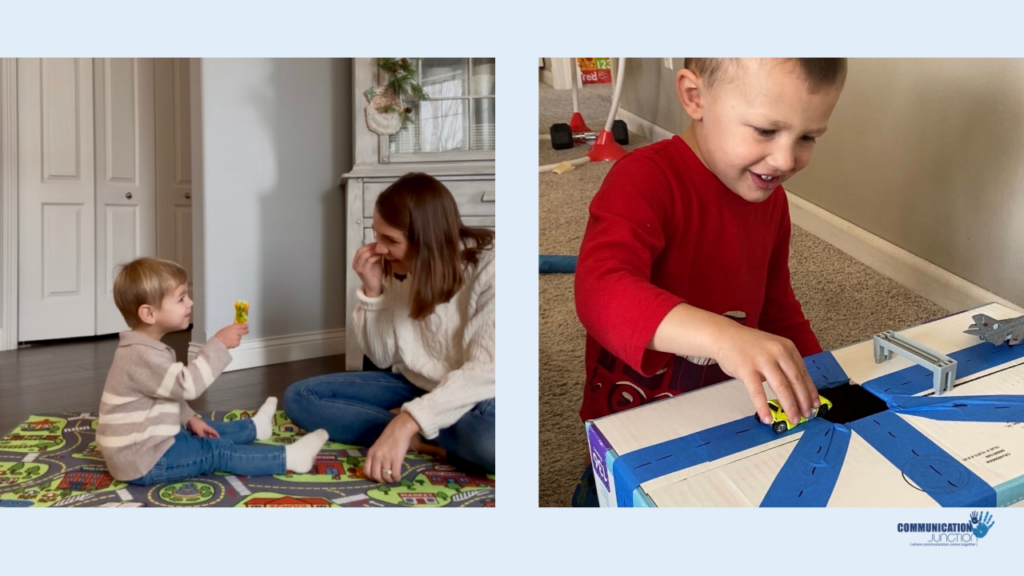
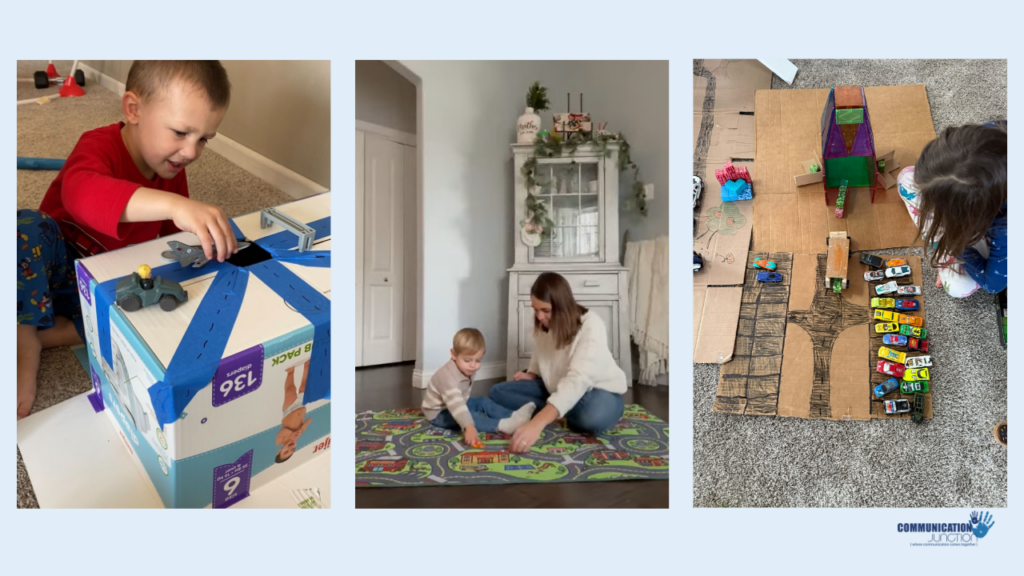
Vehicle play is one of those kids activities that naturally grows with your child and works beautifully across ages. If you have toy cars, trucks, trains, or even just a few boxes, you’re set.
We love a good transportation rug, but it’s absolutely not required. If you have one, great. If not, a few toy vehicles and some open floor space works just as well. Or, grab our free printable version!
You can also grab a few Amazon or shoe boxes and set them up around the house as garages, tunnels, or buildings. Tape roads on the floor. (We love this tape or masking tape.) My boys LOVED this activity. Even better, let the vehicles drive along furniture, pillows, and rugs.
Babies
For babies, it’s all about play, imitation, and shared attention.
- Drive the car slowly and wait to see if they copy you.
- Make fun sounds like “beep beep” or “vroom vroom”.
- Use short phrases: “car,” “car go”
- Sing The Wheels on the Bus (swap in different vehicles).
- Add simple signs and gestures for car, go, or stop.
Want to learn the signs for vehicles?
Check out our YouTube Channel!

You’re laying the foundation for turn-taking and early communication—no words required.
Toddlers
With toddlers, keep playing while gently encouraging words, signs, and routines.
- Model slightly longer phrases: “car go,” “car goes beep beep.”
- Use verbal routines: “1, 2, 3… GO!”
- Practice one-step directions: “Drive to the house.”
- Narrate play: “We’re going to the store for ice cream!”
- Keep singing and signing familiar songs.
Repetition is your friend here. The same play, over and over, is exactly how learning sticks.
Preschoolers
Preschoolers thrive when you follow their lead and increase the complexity just a bit.
- Model full phrases: “The car goes to the store.”
- Try two-step directions: “Go to the store, then the house.”
- Add prepositions: “Go to the store after the house.”
- Flip the script—have them tell you what to do.
- Ask open-ended questions: “What should we get?” or “Why are we going to the library?”
This is where play turns into storytelling, problem-solving, and rich back-and-forth conversation.
2. Snow Play… Inside
We may all be a little over snow at this point—but changing the way you play with it can make it feel brand new again. Whether you have snow outside or need to make your own, snow play is a great sensory and language-rich activity.
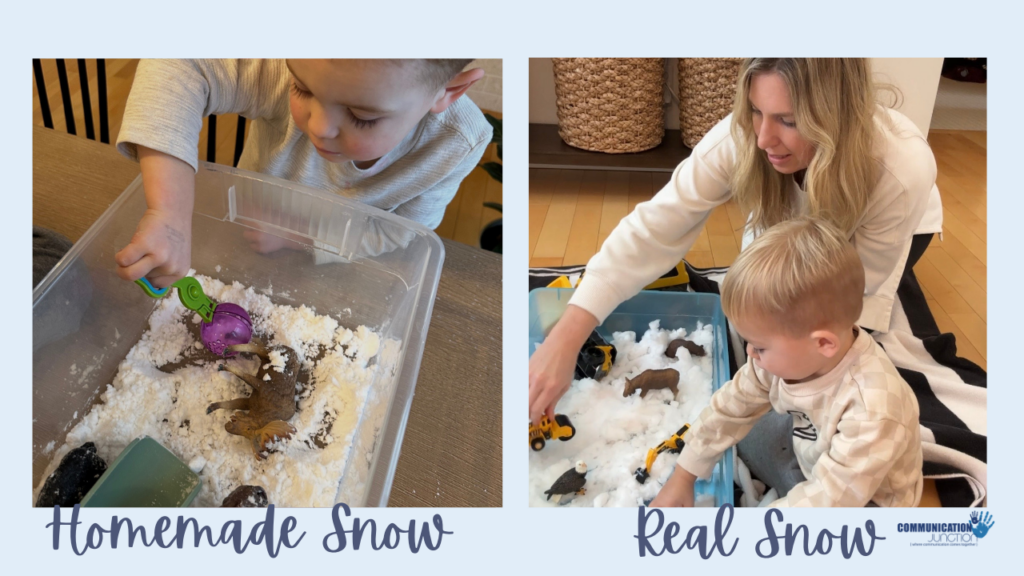
Here is an easy two step recipe to make fun and sensory friendly snow at home.
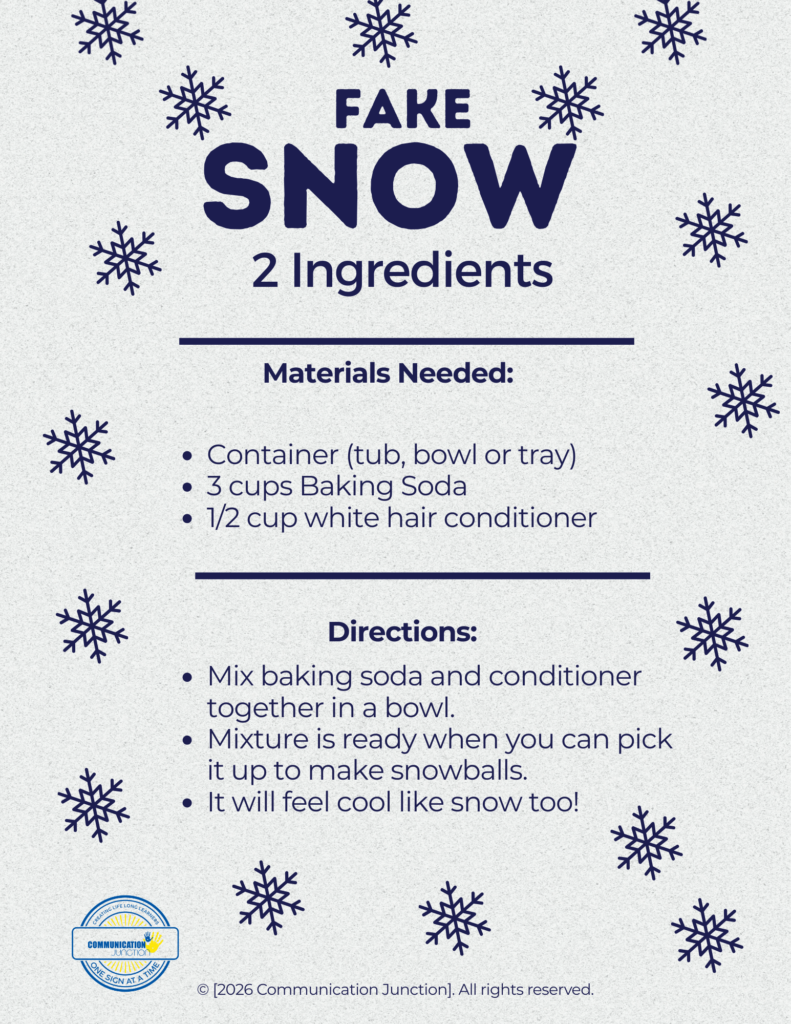
Want us to email this to you?
You can bring in a small bin of real snow, use crushed ice, or even grab cotton balls or white pompoms for pretend snow.
Babies
For babies, snow play is about sensory exploration and shared attention.
- Let them touch, squeeze, or watch snow melt in your hands.
- Talk about what they feel: “cold,” “wet,” “brrr”
- Use simple phrases: “snow,” “cold snow”
- Pair words with gestures or signs for snow and cold.
This is early learning through experience.
Toddlers
With toddlers, keep it playful while modeling words and routines.
- Scoop, dump, and fill containers together
- Model short phrases: “more snow,” “snow in,” “all gone”
- Practice simple contrasts: cold/warm, wet/dry
- Narrate their play: “You’re filling the cup!”
Repetition and hands-on play help concepts stick.
Preschoolers
Preschoolers are ready for more problem-solving and imagination.
- Build structures or create winter scenes by adding animals or little people.
- Talk through what’s happening: “The snow is melting because it’s warm.”
- Ask open-ended questions: “What do we need to build?”
- Experiment together by adding warm water or watching changes over time.
Snow play becomes science, storytelling, and conversation—all at once.
3. Books (Without the Pressure to “Read”)
Books are a favorite for a reason… kids thrive on repetition. But reading the same story over and over can start to feel monotonous for adults. Remember: you don’t have to read every word on the page for books to support early language development.
Want more tips for reading with your little one? Check out our post about the benefits of Reading & Signing!
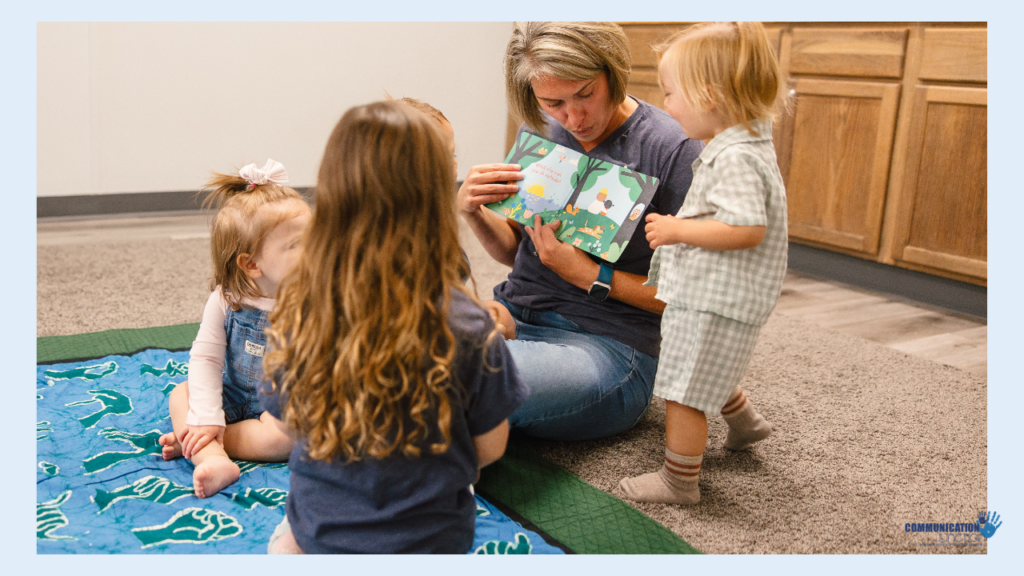
Babies
With babies, book time is about connection, sound, and shared attention.
- Look at pictures together and label what you see.
- Pause and respond to their sounds or movements.
- Use simple words or short phrases instead of reading all the text.
- Add gestures or signs to key words.
Even a minute or two counts.
Toddlers
Toddlers benefit from repetition and participation.
- Let them turn pages or choose the book (even if it’s the same one).
- Ask simple questions: “Where’s the dog?”
- Repeat favorite words and phrases.
- Act out parts of the story together.
The goal is engagement, not finishing the book.
Preschoolers
Preschoolers are ready for deeper conversation and storytelling.
- Predict what will happen next.
- Talk about characters’ feelings.
- Connect the story to real life: “We did that too!”
- Let them retell the story in their own words.
Books become a launching point for rich back-and-forth communication.
Want Someone Else to Do the Entertaining?
If you’d love for someone else to read, or you want a calm, language-rich routine built into your week, join Communication Junction’s Virtual Story Time.
Our virtual story time is:
- Designed for babies, toddlers, and preschoolers.
- Language-rich, but low-pressure.
- Easy to join from home during these long winter weeks.
Let us support you while you support your child—right where you are.
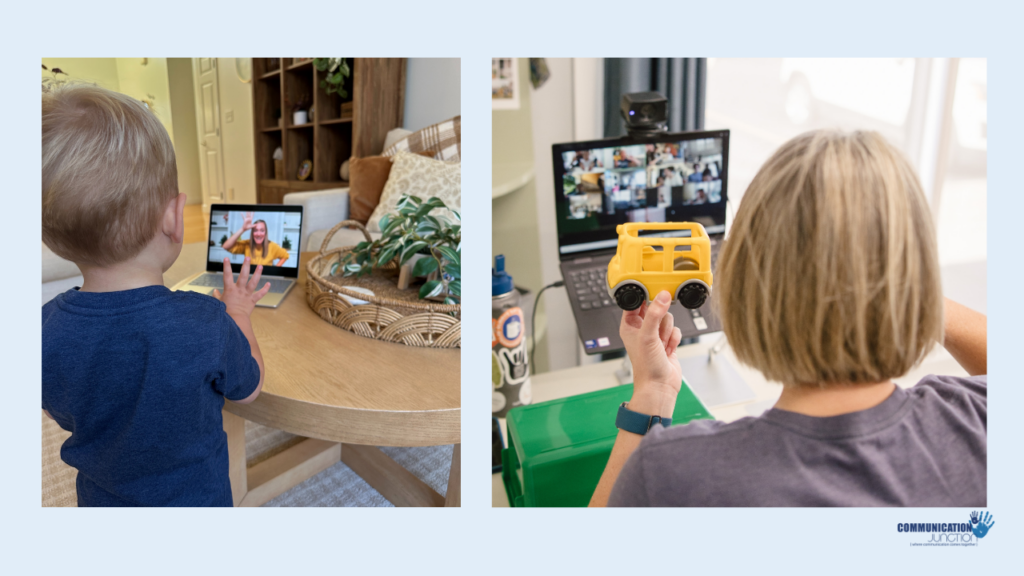
Join Communication Junction’s Virtual Story Time and make winter indoor activities feel a little lighter.
Not quite ready to commit to Story Time yet? That’s ok! Our Read & Sign Library is always available for free on YouTube.
Spring will come. But there’s no reason to wait for the first bloom to help your child’s language grow.